



AI Visibility Platform · Documentation
Business + AI Search Data → Signals → Actions → Tasks → AI Visibility Outcomes
Ansvisor is an open-source AI Search Intelligence Platform that helps brands understand, measure, and improve their visibility across AI Search.
Connect business data and traditional search signals with AI Search behavior across ChatGPT, Google AI Overviews, Google AI Mode, Gemini, Claude, Perplexity, Microsoft Copilot, Grok, and other AI platforms to discover opportunities, prioritize what matters, and improve brand visibility.
Track prompts, mentions, citations, competitors, AI traffic, and the sources AI systems rely on — all in one platform.
Self-host Ansvisor for free or use the managed Ansvisor Cloud.
We're building Ansvisor in the open because we believe companies shouldn't need another black box to understand a black box.
Our goal is to make AI Search intelligence more transparent, measurable, actionable, and accessible.
⭐ If you believe AI Visibility should be open and community-driven, star the repo — it's how the next team discovers Ansvisor.
AI Search is becoming a new layer of how people discover, evaluate, compare, and choose brands.
More than a billion people now use AI tools, with billions of AI-powered queries happening every day. Yet most companies are still early: only a small share have an integrated AI Search strategy, and meaningful brand visibility across AI-generated answers remains limited.
This creates a growing gap between how customers discover information and how companies understand and optimize their presence in that discovery process.
Traditional search data tells you how people find you through search engines. AI Search introduces another layer: which prompts influence discovery, whether your brand appears, how competitors are represented, which sources AI systems rely on, when your website is cited, and whether that visibility translates into traffic and business outcomes.
This shift is making Answer Engine Optimization (AEO), Generative Engine Optimization (GEO), and AI SEO increasingly important.
Ansvisor is built to close this gap.
Instead of treating AI visibility as another isolated analytics dashboard, Ansvisor connects business data, traditional search signals, and AI Search behavior to help teams understand what is happening, discover where opportunities exist, prioritize what matters, and take action.
With Ansvisor, you can:
- AI Search Intelligence Platform — Bring AI visibility, prompts, citations, competitors, AI traffic, content intelligence, and optimization workflows together in one platform.
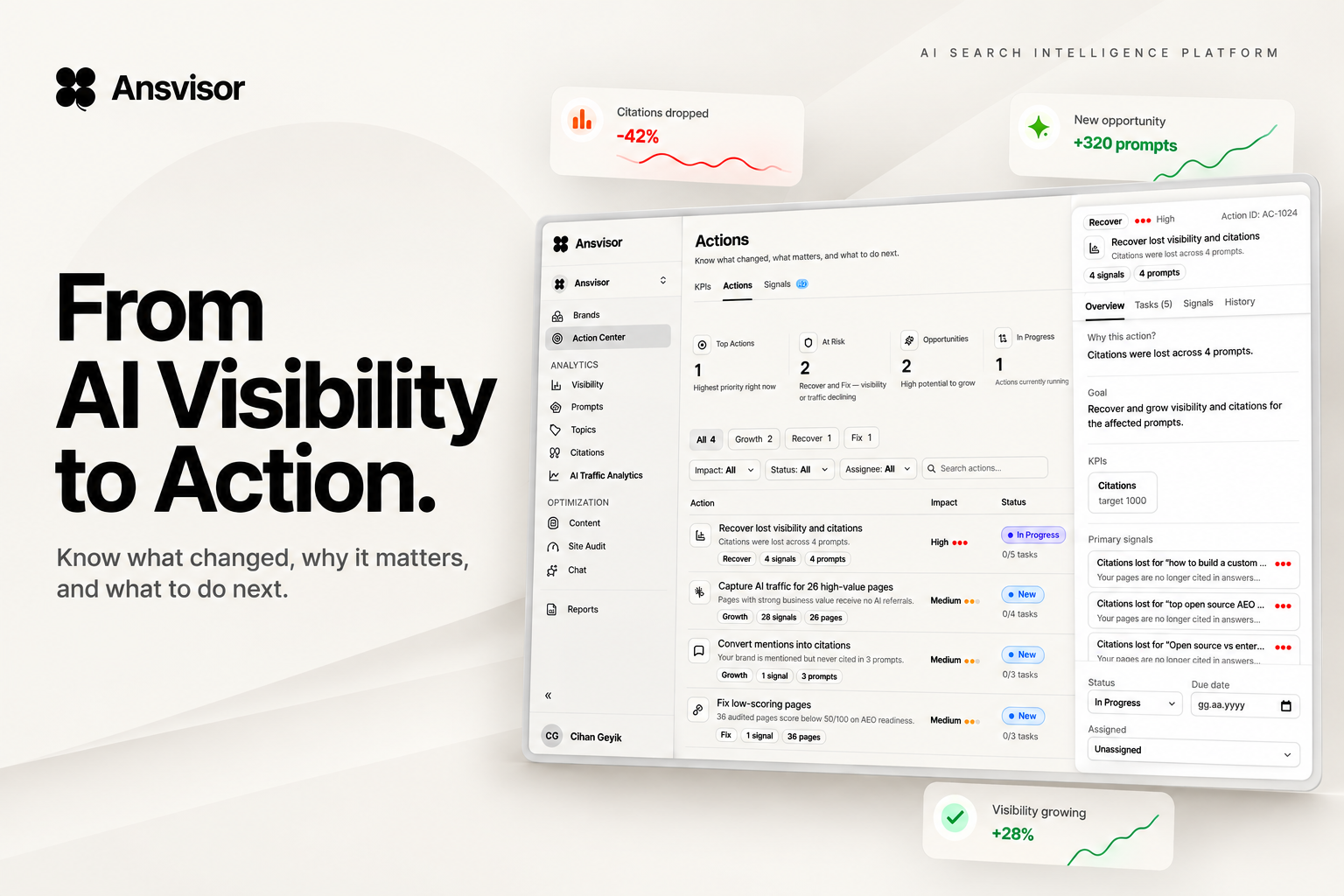
- Action Center — Turn signals across your workspace and connected data sources into prioritized actions and tasks aligned with your AI Search KPIs.
- Answer Engine Insights & AI Visibility — Track how your brand appears, performs, and is represented across leading AI platforms.
- Prompt Monitoring & Volumes — Discover and track relevant prompts, analyze demand, and measure how your visibility changes over time.
- AI Citation Monitoring — Discover which domains, URLs, competitors, and third-party sources AI systems cite.
- Competitor Tracking & Benchmarking — Compare your visibility, citations, mentions, and share of voice with competitors.
- AI Traffic Analytics — Connect AI Search visibility with visits and performance on your website.
- Query Fan-Out — Explore the supporting queries AI systems may generate and use before producing an answer.
- Content Intelligence & Optimization — Identify content gaps, optimization opportunities, and topics based on AI Search behavior.
- AI Visibility Site Audit — Analyze technical and content signals that can affect how AI systems discover, understand, and retrieve your website.
- MCP Server — Connect Ansvisor's AI Search intelligence with AI assistants and agent workflows through the Model Context Protocol (MCP).
The result is a clearer path from fragmented data to useful intelligence:
- 📜 Read the Ansvisor Manifesto
- 🔌 Explore Ansvisor Integrations
- 📖 Explore the AI Visibility Glossary
- ✍️ Read the Blog
- 🔍 Compare Ansvisor vs Alternatives
Ansvisor is built for teams that want transparency, flexibility, and control.
Inspect the code, contribute to the platform, and deploy Ansvisor on your own infrastructure — or use Ansvisor Cloud without managing infrastructure yourself.
Whether you're an enterprise, agency, e-commerce brand, SaaS company, startup, or developer, Ansvisor helps turn business and AI Search data into signals, actions, and tasks designed to improve AI visibility outcomes.
Ansvisor helps you monitor and analyze brand visibility across:
- ChatGPT AI Visibility Tracker
- Google AI Overviews Rank Tracker
- Google AI Mode Rank Tracker
- Gemini AI Visibility Tracker
- Claude AI Visibility Tracker
- Perplexity AI Visibility Tracker
- Microsoft Copilot AI Visibility Tracker
- Grok AI Visibility Tracker
- ChatGPT AI Shopping Tracker
- and other AI-powered discovery experiences
AI Search is still evolving, and we don't believe its measurement and optimization should happen behind another black box.
We're building Ansvisor together with our open-source community around a few simple principles:
- Evidence over dogma
- Measurement over assumptions
- Transparency over black boxes
- Outcomes over vanity metrics
- Collaboration over closed innovation
Developers, marketers, SEO/AEO/GEO practitioners, researchers, agencies, and companies are welcome to contribute through issues, feature ideas, pull requests, testing, documentation, and feedback.
The fastest way to get started without managing infrastructure.
Deploy Ansvisor on your own infrastructure and maintain control over your environment and data.
| Service | Purpose | Where to get |
|---|---|---|
| Supabase | Database, Auth, API | supabase.com |
| AI Provider (at least one) | Brand tracking across AI engines | OpenAI / Google Gemini / Anthropic |
| Cloro | Web scraping for AI platform responses | cloro.ai |
| Service | Purpose | Where to get |
|---|---|---|
| DataForSEO | Keyword volume data for prompt analysis | dataforseo.com |
| Scrape.do | Page fetching for Site Audit (proxy + JS render); required only if you use Site Audit | scrape.do |
| Stripe | Payments (cloud mode only, not needed for self-hosted) | stripe.com |
git clone https://github.com/ansvisor/ansvisor.git
cd ansvisor

cp web/.env.example web/.env.local
cp server/.env.example server/.env
Edit both .env files and fill in your credentials. See the comments in each file for guidance.
Run the migration SQL to create all tables, indexes, RLS policies, and triggers:
Option A — Supabase Dashboard (fresh install, one paste):
- Go to your project's SQL Editor
- Paste the contents of
supabase/schema.sql— the full schema (every migration in one file) — and click Run
Option B — Supabase CLI:
npx supabase link --project-ref <YOUR_PROJECT_REF>
npx supabase db push
supabase/schema.sqlis a generated convenience for fresh installs. The numbered files undersupabase/migrations/stay the source of truth and the upgrade path — an existing install adds only the new migration(s) (ordb push). Regenerate the consolidated file after adding a migration withbash supabase/build-schema.sh.
For local development, supabase/seed.sql ships a small fixture (one demo org, brand, prompts, ~120 prompt results across all tracked engines, competitors, content opportunities, AI traffic logs). It runs automatically the next time you do:
npx supabase db resetSign in with demo@ansvisor.local / demo123 and you'll land on a populated dashboard — no provider API keys needed to iterate on UI. The seed only runs against a local Supabase via the CLI; hosted projects are unaffected.
cd web && yarn install && cd ..
cd server && npm install && cd ..# Terminal 1 — frontend
cd web && yarn dev # http://localhost:3000
# Terminal 2 — backend
cd server && npm run dev # http://localhost:80# Configure env files first, then:
docker compose up --buildSet IS_CLOUD=false (default) in server/.env and NEXT_PUBLIC_IS_CLOUD=false in web/.env.local for self-hosted mode. All features are unlocked automatically — no Stripe or payment setup needed.
ansvisor/
├── web/                 # Next.js 16 frontend (TypeScript)
├── server/              # Express backend (Node.js ESM)
├── supabase/            # Database migrations and config
├── scripts/             # Version management tooling
├── docker-compose.yml   # Containerized deployment
├── CONTRIBUTING.md
├── CHANGELOG.md
└── LICENSE
Frontend — Next.js 16, React 19, TypeScript, Tailwind CSS 4, Supabase Auth, Stripe, Zustand, Recharts, next-intl
Backend — Express, Vercel AI SDK, multi-provider AI (OpenAI, Anthropic, Google, Perplexity, Grok), Supabase, Socket.IO, Zod
What we're planning to build next. React with 👍 on the linked issue (or open a new one) to push something up the list. PRs welcome on any of these.
- Ansvisor MCP server — expose insights through a Model Context Protocol server so Claude Desktop, Claude Code, Cursor, Zed, and any other MCP client can query your brand visibility directly. Remote (Streamable HTTP) endpoint at
/api/mcp— zero install, paste a URL + API key into your client and you're done. Ships withlist_brandsandget_visibility_summarytoday; more tools landing as we go. - Anthropic Skills — opinionated AEO knowledge that turns Claude into an analyst on your account. Ships in two flavours: an MCP-tool flavour for Claude Desktop / Claude Code / Cursor / Zed, and a standalone REST flavour for claude.ai web (no MCP required). First skill (
ansvisor-aeo-coach) is live — seeskills/. More (page-audit, rewrite-for-aeo, content-brief) on the way. - In-product conversational AI assistant — chat with your dashboard about visibility trends, competitor moves, and content gaps without leaving the page
- ScrapeLLM integration — add ScrapeLLM as an alternative scraping backend alongside Cloro for users who prefer it or need a fallback
- PostHog integration — pipe AI-referred sessions and tracking events into PostHog for users already running it as their product analytics layer
- Daily Pulse — a per-brand daily digest email after each tracking run: KPI strip, highlights (first citations, prompt gains, leaderboard overtakes) and anomaly warnings (sharp visibility drops, competitor surges, lost citations), plus a
daily_pulse.createdwebhook event for Slack/Notion delivery (#540) - BYO LLM keys — bring your own OpenAI / Anthropic / Gemini API key for tracking and content generation, so you control cost and data handling
- Webhook recipe library — one-click Notion / Linear / Asana / Slack templates so a Content Brief can land in your editorial workflow with zero glue code
See an idea missing? Check the Ideas discussions — upvote an existing one or open a new thread.
We welcome contributions! See CONTRIBUTING.md for development setup, branch naming, commit conventions, and PR guidelines.
MIT — Copyright (c) 2026 Empler AI Inc.